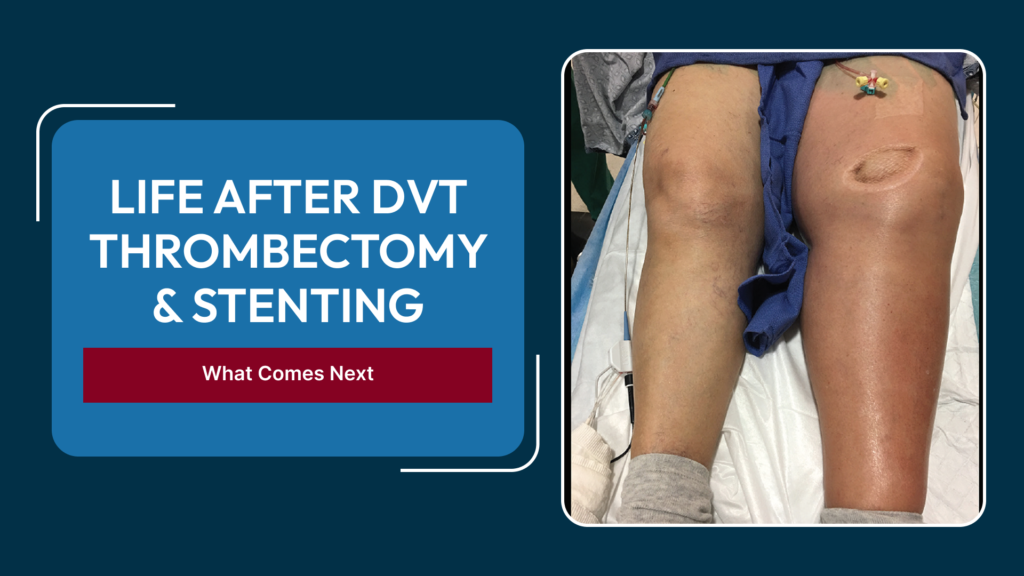
Completing a DVT thrombectomy or having a venous stent placed to relieve iliac vein compression is a significant step — one that most patients arrive at after weeks or months of dealing with a painful, swollen leg, recurrent clot episodes, or both. The procedure itself, when performed by an experienced Best Endovascular Surgeon In Delhi, is technically demanding but typically completed without large incisions and with a relatively short hospital stay. What happens in the weeks, months, and years that follow, however, is equally important — and often less clearly explained to patients at the time of discharge. This guide answers the questions that patients most commonly ask after DVT thrombectomy or iliac vein stenting: how long anticoagulation continues, when follow-up imaging is scheduled and what it looks for, how to manage residual swelling, what compression garments are needed and for how long, and when it is safe to travel, exercise, and resume a fully normal life.
The First 24 to 48 Hours After Procedure: What to Expect
Immediately after the procedure, the access site — usually the popliteal vein behind the knee or the femoral vein in the groin — is compressed and a small dressing applied. Most patients experience some soreness at the access site and some ongoing leg heaviness, which is normal. In many cases, the improvement in swelling begins to be noticeable within the first twenty-four hours as the newly opened or stented vein drains the accumulated venous congestion.
Patients are typically monitored overnight with duplex ultrasound performed either before discharge or at the first post-procedure visit to confirm early stent patency. Anticoagulation — either injectable low molecular weight heparin or an oral anticoagulant — is continued without interruption through and beyond the procedure, since the immediate post-stenting period carries the highest risk of stent thrombosis and requires therapeutic anticoagulation to protect the newly placed stent while the vein wall heals around it.
Anticoagulation After DVT Thrombectomy or Venous Stenting: How Long and Which Drug?
The Standard Anticoagulation Period
The duration of anticoagulation after venous stenting or mechanical thrombectomy is not the same for all patients, and this is one of the most important questions to discuss explicitly with the treating Best DVT Treatment Doctor In Delhi before discharge. As a general framework, most patients receive full therapeutic anticoagulation for a minimum of three to six months after the procedure, after which the decision to continue, reduce, or stop anticoagulation is made based on several factors including stent patency on follow-up imaging, the underlying cause of the DVT, and the patient’s individual thrombophilia profile.
Patients With Underlying May-Thurner Syndrome
For patients whose DVT occurred secondary to May-Thurner Syndrome and iliac vein compression, the mechanical cause of thrombosis has been addressed by the stenting procedure. Provided the stent is patent and well-positioned on follow-up imaging, anticoagulation duration may be shorter than in patients with a strong underlying thrombophilic tendency, though most teams continue anticoagulation for at least three months post-stenting to protect stent patency during the early endothelialisation period.
Patients With Underlying Thrombophilia
Patients who have a confirmed inherited thrombophilia — such as Factor V Leiden, Prothrombin gene mutation, antiphospholipid syndrome, or deficiencies of Protein C, Protein S, or Antithrombin — may require indefinite anticoagulation regardless of stent patency, since the underlying prothrombotic state that caused the original DVT persists after stenting. The haematologist involved in the patient’s care typically makes this recommendation in conjunction with the vascular team.
Drug Choices: DOAC vs Warfarin
Modern direct oral anticoagulants (DOACs) — including rivaroxaban, apixaban, and dabigatran — are increasingly preferred over warfarin for venous stenting patients because they do not require INR monitoring, have fewer drug and food interactions, and carry a modestly lower bleeding risk for most indications. However, the evidence base for DOACs specifically in venous stenting is less mature than for venous thromboembolism generally, and some centres still prefer warfarin for the first post-stenting months or for patients with antiphospholipid syndrome, where warfarin remains the standard of care.
Follow-Up Imaging: What Scans Are Needed and When?
Immediate Post-Procedure Duplex
A duplex Doppler ultrasound is typically performed within one to two days of the procedure or at the first outpatient review, to confirm early stent patency and identify any immediate mechanical complications such as stent migration or significant residual stenosis that was not recognised at the time of the procedure.
Short-Term Follow-Up at One to Three Months
A repeat duplex ultrasound at approximately six to twelve weeks confirms that the stent remains patent and assesses whether the swelling and clinical symptoms have improved as expected. At this visit, the anticoagulation plan is typically reviewed and a decision made about whether to continue the current drug and dose, switch agents, or begin discussions about a possible future anticoagulation holiday if imaging is reassuring.
Medium-Term Follow-Up at Six Months and One Year
Duplex ultrasound at six months and at one year post-stenting are important surveillance points for detecting in-stent restenosis — gradual narrowing of the stented segment due to neointimal ingrowth or external compression of the stent — which is the most common long-term complication of venous stenting. In-stent restenosis detected early, before it progresses to complete stent occlusion, is amenable to balloon angioplasty within the stent and carries an excellent outcome. Restenosis detected late, after stent occlusion, is more complex and more difficult to treat.
Annual Surveillance Beyond One Year
Most experienced teams continue annual duplex surveillance indefinitely for venous stenting patients, since late stent restenosis can occur beyond the first year and is more likely in patients with ongoing venous hypertension, chronic inflammatory conditions, or incomplete anticoagulation coverage in the early post-stenting period. The burden of an annual scan is low compared to the consequence of missing a treatable restenosis.
Compression Garments After Stenting: Still Important?
Yes. Even with a patent, well-functioning venous stent, many patients continue to have some degree of residual deep venous valve incompetence from the damage caused by the original DVT — the underlying mechanism of post-thrombotic syndrome. Graduated compression stockings (typically class II, 20–30 mmHg or 30–40 mmHg depending on symptom severity) support the calf muscle pump, reduce venous pressure in the lower leg, and control the residual swelling that the stent alone cannot fully address.
Many patients notice that their leg swelling is substantially improved but not completely resolved after stenting, and that compression makes a meaningful additional difference — particularly on days involving prolonged standing, travelling, or warm weather. The duration of compression garment use is typically at least one to two years post-procedure, and many patients continue using compression long-term as an ongoing management strategy for their chronic venous disease rather than as a temporary post-procedural measure.
Managing Persistent or Residual Leg Swelling After Stenting
Some degree of residual swelling in the weeks following stenting is expected and does not necessarily indicate a problem. The vein wall and surrounding tissues take time to accommodate the new venous drainage pathway, and the oedema that accumulated during the period of venous obstruction takes weeks to fully resolve, particularly in patients who had severe symptoms prior to the procedure.
- Elevate the leg above heart level for at least thirty to sixty minutes per day, particularly in the early post-procedure weeks.
- Walk regularly — the calf muscle pump is the most effective active mechanism for reducing venous leg oedema.
- Wear compression stockings consistently during all waking hours unless specifically advised otherwise.
- Avoid prolonged standing without movement — if standing is unavoidable, shift weight and rise on the toes periodically to activate the calf pump.
- Return for review if swelling is worsening rather than gradually improving, or if new pain develops suddenly — these may indicate stent thrombosis and require urgent imaging.
Travel After DVT Thrombectomy or Venous Stenting
Air Travel: When Is It Safe?
Air travel involves prolonged immobility in a seated position with low cabin humidity and reduced atmospheric pressure, all of which contribute to venous stasis and dehydration — factors that increase DVT risk in healthy individuals and more so in patients who have recently undergone venous stenting. Most endovascular teams advise avoiding long-haul air travel for at least four to six weeks after a stenting procedure, and recommend short-haul travel only with specific precautions during this period.
Travel Precautions Once Cleared to Fly
- Choose an aisle seat and walk the cabin at least once per hour of flight.
- Perform regular seated calf exercises — ankle circles, heel raises, calf pumps — throughout the flight.
- Stay well hydrated and avoid excess alcohol, which causes vasodilatation and dehydration.
- Wear compression stockings rated at least 15–20 mmHg for any flight longer than ninety minutes.
- Carry the anticoagulation medication in hand luggage and take the dose on schedule regardless of time zone changes.
Long-Distance Car, Train, and Bus Travel
The same principles apply to any long-distance travel involving prolonged sitting. Take regular breaks to walk, stay hydrated, and wear compression. These are habits worth developing permanently rather than treating as temporary post-procedure precautions, since patients with chronic venous disease always have a higher baseline thrombotic risk during prolonged immobility.
Exercise and Physical Activity After Thrombectomy or Stenting
Gentle, regular walking is actively encouraged from the day after the procedure. The calf muscle pump is critical to venous return, and sedentary recovery is counter-productive in venous disease. The stent itself is robust and unaffected by normal physical activity including walking, cycling, and swimming.
Higher-impact activities — running, team sports, heavy weightlifting — are generally restricted for four to six weeks post-procedure to allow the access site to fully heal and to avoid the raised intra-abdominal pressures associated with heavy exertion that could, theoretically, transmit additional pressure to the stented venous segment. Beyond this initial period, there are typically no permanent physical activity restrictions related to the stent.
Warning Signs That Require Urgent Attention
- Sudden worsening of leg swelling or pain after a period of improvement — possible early stent thrombosis.
- Leg turning significantly blue-purple, tense, and acutely painful — possible acute stent occlusion or new extensive DVT.
- Sudden breathlessness, chest pain, or rapid heart rate — possible pulmonary embolism, particularly in the early post-procedure period.
- Access site bleeding that does not stop with pressure — requires immediate medical assessment.
- High fever with leg pain and redness — possible infection, though rare in endovascular procedures.
Frequently Asked Questions
Will I need a venous stent for life?
Yes. Venous stents are permanent devices. They do not need to be replaced under normal circumstances, and most modern venous stents maintain excellent structural integrity over decades. Annual duplex surveillance monitors for in-stent restenosis, which is treatable with balloon angioplasty inside the stent if detected early.
Can I feel the stent in my leg?
The venous stent is placed in the iliac vein deep within the pelvis. Patients virtually never feel the stent itself. The reduction in leg heaviness and swelling that most patients notice in the days and weeks after the procedure is the result of improved venous drainage rather than any physical sensation from the stent.
How will I know if my stent is blocking?
Early stent thrombosis typically presents as sudden worsening of leg swelling and pain after a period of post-procedure improvement. Gradual in-stent restenosis may present more subtly, as slowly worsening oedema over months, which is one reason annual duplex surveillance is so important even in asymptomatic patients.
Can I take anti-inflammatory drugs like ibuprofen while on anticoagulation?
Non-steroidal anti-inflammatory drugs (NSAIDs) including ibuprofen significantly increase bleeding risk when combined with anticoagulants and should be avoided unless specifically directed by the treating physician. Paracetamol is the safe alternative for pain relief in anticoagulated patients.
My doctor mentioned May-Thurner Syndrome caused my DVT — does the stent fix this permanently?
A correctly sized and placed venous stent effectively bridges the compression point and prevents it from narrowing the vein again, since the stent is structurally rigid and the artery can no longer compress it significantly. With correct stenting and appropriate anticoagulation in the early period, most patients with May-Thurner Syndrome treated by iliac vein stenting achieve excellent long-term patency and a durable end to the cycle of recurrent DVT.
Will I develop post-thrombotic syndrome even after thrombectomy and stenting?
Thrombectomy and stenting substantially reduce — but do not eliminate — the risk of post-thrombotic syndrome compared to anticoagulation alone. The degree of deep vein valve damage that occurred before and during the DVT episode, and how promptly the clot was removed, both influence the long-term outcome. Detailed information about post-thrombotic syndrome, its symptoms, and its management is available in our dedicated guide on post-thrombotic syndrome after DVT.
Conclusion
DVT thrombectomy and venous stenting offer patients with extensive DVT and iliac vein obstruction a chance for more complete venous recovery than anticoagulation alone can provide. But the procedure is only the beginning of a defined recovery journey that includes careful anticoagulation management, structured follow-up imaging, consistent use of compression garments, sensible activity and travel planning, and vigilance for the warning signs that require prompt medical attention. A well-informed patient who understands this roadmap is far better positioned to protect the investment of the procedure and achieve the best possible long-term outcome. The treating Best Vascular Surgeon In Delhi should provide clear, individualised guidance on each of these areas before discharge rather than leaving patients to navigate the post-procedure period with unanswered questions.
Questions About Recovery After DVT Thrombectomy or Stenting?
Whether you are preparing for a procedure or navigating recovery after one, our team is here to provide clear, personalised guidance. Book a follow-up consultation with our DVT and endovascular specialist team.