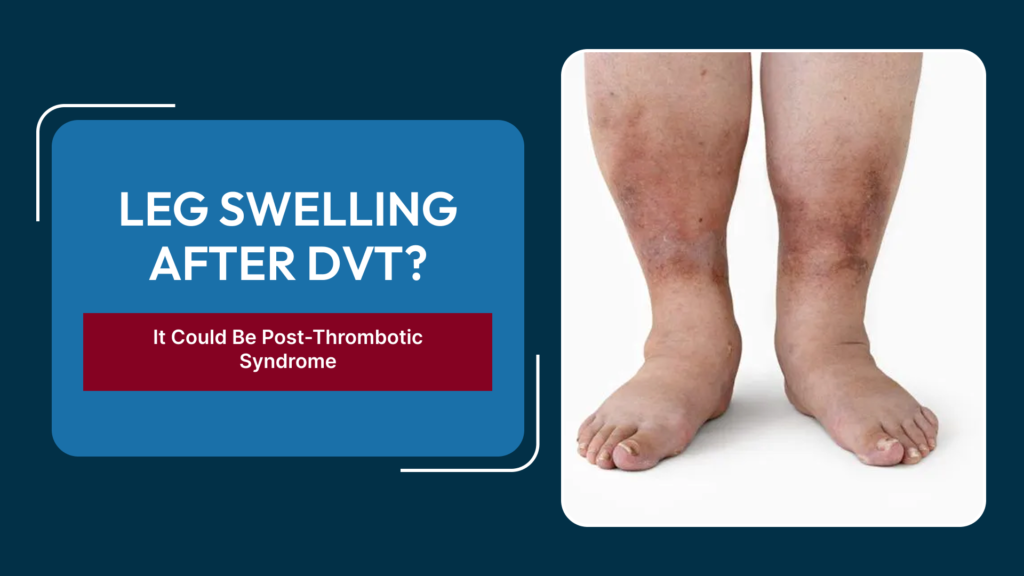
One of the most distressing experiences a DVT patient faces is being told that their blood clot has resolved, their anticoagulation can be stopped, and their treatment is complete — only to find that their leg is still swollen, heavy, discoloured, and painful months or years later. This is not treatment failure, and it is not the patient imagining symptoms. It is post-thrombotic syndrome: a distinct, chronic condition that develops as a consequence of the vein damage caused by the original DVT. Understanding why it happens, what makes it worse, how it presents across a spectrum from mild to severely disabling, and what a specialist in DVT Treatment In Delhi can offer for its management is essential information for any patient recovering from deep vein thrombosis.
What Is Post-Thrombotic Syndrome?
Post-thrombotic syndrome, abbreviated PTS, is a chronic venous insufficiency syndrome caused by the structural damage that DVT inflicts on the deep vein wall and, most critically, on the venous valves. Healthy veins contain one-way valves that prevent blood from flowing backwards (refluxing) between heartbeats. When a clot forms within a vein, the inflammatory process triggered by the clot damages these delicate valve leaflets, leaving them scarred, thickened, and unable to close properly. Even after the clot dissolves or is removed, the damaged valves remain incompetent indefinitely.
This valve incompetence causes venous reflux — blood pooling and flowing backwards in the superficial and deep venous system under the influence of gravity — generating abnormally high pressure within the veins of the lower leg, a state called chronic venous hypertension. The leg swells because the elevated pressure forces fluid out of the capillaries and into the surrounding tissues. Pain, heaviness, and aching develop because the distended veins and congested tissues are under constant mechanical stress with every step.
How Common Is Post-Thrombotic Syndrome After DVT?
PTS is not a rare complication. Depending on the location and extent of the original DVT, the effectiveness of initial treatment, and the patient’s adherence to compression therapy, studies consistently estimate that between twenty and fifty percent of DVT patients develop some degree of PTS within two years of their initial clot. Severe PTS — characterised by significant swelling, skin changes, and eventually venous ulceration — affects approximately five to ten percent of all DVT patients, representing a substantial burden of chronic disability that outlasts the acute event by decades.
Risk Factors: Who Is Most Likely to Develop Post-Thrombotic Syndrome?
Location and Extent of the Original DVT
Proximal DVT — clot extending into the femoral or iliac vein — carries a substantially higher risk of PTS than distal DVT confined to the calf, simply because valve damage in the larger, proximal veins causes more severe and widespread venous hypertension. Ilio-femoral DVT, particularly that associated with May-Thurner Syndrome and iliac vein compression, is the highest-risk category.
Inadequacy of Initial DVT Treatment
Patients treated with anticoagulation alone, particularly for proximal DVT, are more likely to retain residual thrombus that becomes fibrosed and permanently incorporated into the vein wall. This residual obstruction, combined with valve damage, creates the most severe conditions for PTS development. This is one of the central arguments for considering early mechanical thrombectomy in appropriate patients with proximal DVT — removing the clot promptly protects the vein wall and valves from the prolonged inflammatory insult caused by persistent thrombus.
Recurrent DVT in the Same Leg
Each episode of DVT in the same venous segment adds cumulative valve and wall damage, substantially increasing both the risk and severity of subsequent PTS. This is why identifying and treating the underlying cause of recurrent DVT — including structural problems like iliac vein compression — is so important rather than simply managing each episode in isolation.
Obesity and Reduced Mobility
Both factors independently worsen venous return and venous hypertension, compounding the haemodynamic consequences of valve incompetence in patients who already have underlying vein damage from DVT.
Failure to Use Compression Stockings in the Acute Phase
Evidence supports the use of graduated compression stockings in the first weeks to months after proximal DVT to reduce venous pressure and swelling during the period when the vein is recovering and residual clot is dissolving. Patients who do not consistently use compression in this period appear to have higher rates of PTS, though the optimal compression protocol remains an area of active investigation.
How Post-Thrombotic Syndrome Presents: A Spectrum of Severity
Mild Post-Thrombotic Syndrome
The earliest and mildest manifestations are intermittent leg heaviness and aching that worsens after prolonged standing or at the end of the day, with ankle swelling that partly resolves overnight with leg elevation. Many patients in this group assume these symptoms are simply ‘normal’ residual effects of their DVT and do not seek further evaluation, missing the window for preventive intervention.
Moderate Post-Thrombotic Syndrome
More established PTS produces persistent ankle and lower leg swelling that does not fully resolve overnight, chronic aching and heaviness throughout the day, and the beginning of skin changes — reddish-brown discolouration of the lower leg called haemosiderin staining, caused by iron from extravasated red blood cells depositing in the skin over time.
Severe Post-Thrombotic Syndrome
At its most severe, PTS causes indurated, thickened, woody skin over the lower leg (lipodermatosclerosis), recurrent skin infections (cellulitis), and eventually the development of chronic venous ulcers — open wounds typically around the inner ankle that are notoriously difficult to heal, prone to recurrence, and represent a major source of disability, reduced quality of life, and healthcare utilisation for affected patients.
Diagnosing Post-Thrombotic Syndrome: What Investigations Confirm It?
The diagnosis of PTS is primarily clinical, based on the history of prior DVT combined with the characteristic pattern of symptoms and signs. Duplex Doppler ultrasound is the standard investigation to assess venous reflux and identify whether the deep and superficial systems show the valve incompetence typical of post-thrombotic change. In patients with significant swelling despite adequate superficial compression, cross-sectional imaging or intravascular ultrasound may be needed to identify a residual outflow obstruction that is driving the venous hypertension from the other direction — from above rather than from reflux below.
Management of Post-Thrombotic Syndrome
Compression Therapy: The Foundation
Graduated compression — typically in the form of medical-grade compression stockings or, in more severe cases, multilayer compression bandaging — remains the cornerstone of PTS management. Compression reduces venous diameter, improves the calf muscle pump, and lowers venous pressure in the lower leg. Consistency is critical: the benefit comes from consistent daily use, particularly during standing and walking hours, and dissipates rapidly when compliance lapses.
Addressing Residual Venous Obstruction
In patients where significant outflow obstruction persists at the iliac or femoral vein level — whether from residual organised thrombus or from a structural cause like May-Thurner Syndrome that was not addressed at the time of the original DVT — endovascular intervention to relieve that obstruction through balloon angioplasty and venous stenting can substantially reduce the venous pressure that compression alone cannot overcome. The diagnostic imaging approach that guides this decision is covered in our guide on how IVUS, venography, and CT venography are used to identify venous blockages.
Wound Care for Venous Ulcers
Established venous ulcers require specialist wound care with compression, appropriate dressings, and in some cases skin grafting to achieve healing. Healing without addressing the underlying venous hypertension is rarely durable, and ulcers recur until the root cause — valve incompetence, obstruction, or both — is appropriately managed.
Physical Activity and Weight Management
Regular walking activates the calf muscle pump, the primary mechanism that drives venous blood upward against gravity, and is actively beneficial in PTS rather than contraindicated as many patients assume. Maintaining a healthy weight reduces the additional hydrostatic venous load that obesity imposes on an already compromised venous system.
The Relationship Between Post-Thrombotic Syndrome and Varicose Veins
In some patients with PTS, the chronically elevated deep venous pressure causes secondary incompetence and dilatation of the superficial veins, producing varicose veins that appear or worsen after the DVT. This is a distinct mechanism from primary varicose veins, and treating these secondary varicosities without first understanding and addressing the underlying deep venous problem leads to early recurrence. Our article on why varicose veins return after treatment when deep vein or iliac vein problems are present explains this relationship in detail and is important reading for anyone whose varicose veins developed or recurred following a DVT.
Frequently Asked Questions
Is post-thrombotic syndrome permanent?
The valve damage that underlies PTS is generally permanent, but the severity of symptoms can be substantially managed with consistent compression therapy, activity, and, where appropriate, correction of residual venous obstruction through endovascular treatment.
Can post-thrombotic syndrome develop even if my DVT was treated promptly?
Yes, though the risk is lower with early, effective treatment. Even prompt anticoagulation does not guarantee complete valve preservation, particularly in extensive or proximal DVT.
How long after DVT does post-thrombotic syndrome typically appear?
Symptoms may begin within weeks of the DVT in severe cases, but most patients develop recognisable PTS within one to two years of the original clot. The risk period extends for several years, so follow-up beyond the acute treatment phase is important.
Should I see a vascular surgeon or a haematologist for post-thrombotic syndrome?
Both specialists may be involved, but a vascular surgeon experienced in venous disease is specifically trained to assess the haemodynamic consequences of PTS and consider structural interventions. A haematologist manages the anticoagulation and thrombophilia aspects. Ideally, a Best Vascular Surgeon In Delhi with venous expertise should evaluate any patient with significant PTS symptoms.
Will my PTS get worse over time if left untreated?
Yes. Without consistent compression and, where needed, relief of venous obstruction, PTS typically progresses from mild symptoms through skin changes to ulceration over a variable timeframe that depends on activity level, weight, compliance with compression, and the severity of the underlying venous damage.
Conclusion
Post-thrombotic syndrome is a chronic, progressive consequence of DVT-related venous damage that continues long after the acute clot has resolved. Its impact on quality of life rivals many well-recognised chronic conditions, yet it remains underdiagnosed and undertreated because patients and clinicians sometimes accept persistent leg symptoms as an inevitable outcome rather than a manageable syndrome with specific interventions. Understanding the mechanisms, recognising the symptoms early, and seeking specialist evaluation from a vascular surgeon experienced in chronic venous disease gives patients the best possible chance of managing PTS effectively and preventing its progression to severe disability.
Chronic Leg Swelling After DVT? Get a Specialist Assessment
If you have persistent leg swelling, pain, or skin changes months or years after DVT, book a consultation with our vascular team for a thorough venous assessment and a personalised management plan.