Patients scheduled for a leg angioplasty — or recovering from one — almost universally want to know two things: how quickly will I feel better, and how long will the results last? These are exactly the right questions to ask, and the answers depend heavily on the specific type and location of arterial disease being treated, the technique used, and how well underlying risk factors are managed after the procedure. This guide provides an honest, evidence-based overview of what patients and their families can realistically expect.
If you are still in the decision-making phase about whether angioplasty is the right treatment for your arterial disease, it helps to first understand the broader clinical context, including the early warning signs that suggest blocked leg arteries and how conditions like peripheral artery disease progresses from walking pain to more severe ischaemia. An Endovascular Surgeon In Delhi can then advise whether angioplasty, stenting, bypass, or medical management is most appropriate for your specific anatomy.
What Is Leg Angioplasty and What Does It Treat?
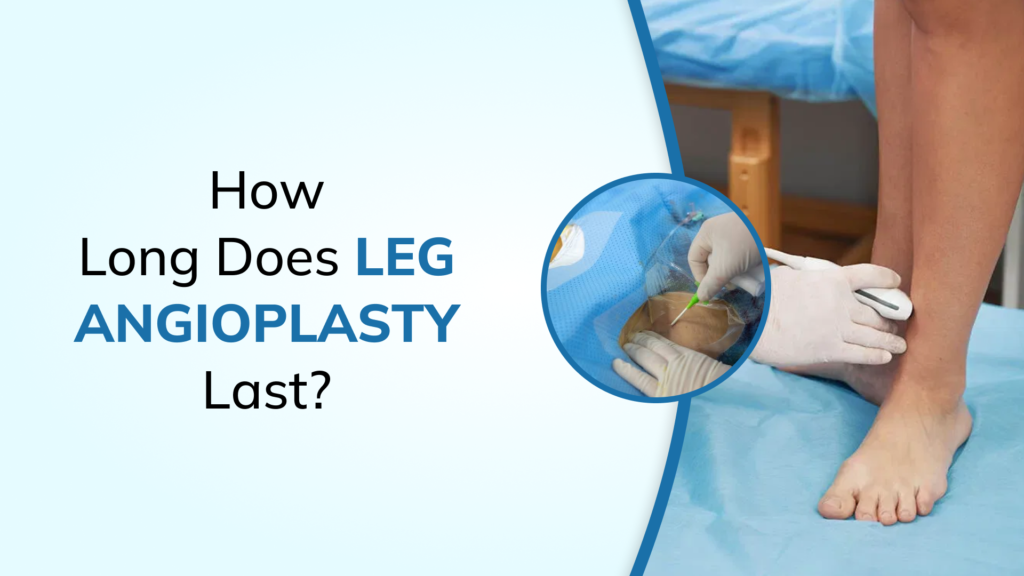
Leg angioplasty, formally known as Peripheral Transluminal Angioplasty (PTA), is a minimally invasive endovascular procedure designed to open narrowed or blocked arteries in the legs without open surgery. A thin, flexible catheter is introduced into the arterial system through a small puncture site — typically in the groin or the wrist — and navigated under X-ray guidance to the site of the blockage. A small balloon at the catheter tip is then inflated to compress the plaque against the arterial wall and restore the lumen diameter.
In many cases, particularly when the artery is at risk of re-narrowing due to elastic recoil or the nature of the plaque, a stent — a small, mesh-like metallic scaffold — is deployed inside the vessel after balloon inflation to maintain the opening. Drug-coated balloons and drug-eluting stents, which release medication locally to reduce the risk of re-narrowing, have become increasingly standard tools in modern endovascular practice.
Which Arteries Are Typically Treated With Angioplasty?
- Iliac arteries — the large vessels supplying blood to the legs from the aorta, with some of the highest long-term success rates for angioplasty.
- Superficial femoral artery (SFA) — the most commonly treated artery in the thigh, with results that vary significantly based on lesion length.
- Popliteal artery — behind the knee, treatable with angioplasty though anatomically challenging due to its role in joint movement.
- Below-knee arteries (tibial and peroneal arteries) — treated primarily in critical limb ischaemia and diabetic foot cases where limb salvage is the goal.
- AV fistula angioplasty — a specific application for patients on haemodialysis whose arteriovenous fistula has narrowed, reducing dialysis effectiveness.
How Long Do Angioplasty Results Typically Last?
The durability of leg angioplasty results varies significantly by the location of treatment, the characteristics of the disease, and the technology used:
Iliac Artery Angioplasty and Stenting
Iliac artery interventions consistently demonstrate the best long-term results of all peripheral vascular angioplasty sites. Five-year primary patency rates — meaning the treated segment remains open without any reintervention — are reported at 70 to 85 percent for iliac artery stenting. For claudication patients (as opposed to critical limb ischaemia patients, where disease is more diffuse), results are even more favourable. Many patients with successful iliac stenting have open, functional stents more than ten years post-procedure.
Superficial Femoral Artery Angioplasty
The SFA is the most technically challenging common angioplasty site because it spans the full length of the thigh, undergoes significant bending and compression with leg movement, and is often affected by long-segment disease. With conventional balloon angioplasty alone, five-year patency rates were historically 40 to 50 percent. The introduction of drug-coated balloons and dedicated SFA stent systems has improved this substantially, with contemporary series reporting 60 to 70 percent five-year patency for appropriate lesion types.
Below-Knee (Infrapopliteal) Angioplasty
Below-knee angioplasty for critical limb ischaemia is performed primarily to heal wounds and save limbs rather than to maintain long-term arterial patency. Even if the treated vessel re-narrows within twelve to eighteen months, the temporary restoration of blood flow during the healing period is often sufficient to allow wound closure and prevent amputation. Success in this setting is measured by limb salvage rates rather than traditional patency metrics.
AV Fistula Angioplasty
AV fistula angioplasty for dialysis access stenosis provides effective short-to-medium term restoration of fistula function, with primary patency at one year typically in the range of 40 to 60 percent. However, repeat angioplasty for fistula stenosis is straightforward, carries low risk, and can be performed multiple times, making it the standard approach for maintaining long-term dialysis access.
What Is the Immediate Success Rate of Leg Angioplasty?
Technical success — defined as achieving at least 30 percent residual stenosis or less immediately after the procedure under fluoroscopic imaging — is achieved in over 90 percent of appropriately selected peripheral arterial interventions by experienced operators. Clinical success, meaning the patient experiences meaningful improvement in symptoms or wound healing, follows in the vast majority of technically successful procedures.
Patient selection and imaging-guided planning are critical determinants of success. Modern Best Endovascular Surgeon In Delhi teams use CT angiography to map the complete arterial anatomy from the aorta to the foot before planning any intervention, ensuring the treatment strategy addresses the entire haemodynamically significant disease burden rather than just the most visible lesion.
What Does Recovery From Leg Angioplasty Look Like?
Immediately After the Procedure
Most leg angioplasty procedures are performed under local anaesthesia with sedation. The entire procedure typically takes 60 to 120 minutes depending on disease complexity. After a period of bed rest to allow the puncture site to seal — usually two to four hours — patients can mobilise and are often discharged on the same day or after an overnight stay.
First Week After Angioplasty
The puncture site in the groin or wrist may be tender and mildly bruised. Patients are advised to avoid heavy lifting, strenuous exercise, and driving for approximately one week. Most patients can resume gentle walking — in fact, encouraged to do so — within 24 to 48 hours of the procedure.
First Month
Many patients experience a notable improvement in walking distance within days to weeks of a successful iliac or SFA angioplasty. For below-knee angioplasty performed for wound healing, improvement in the wound itself may take four to eight weeks to become apparent even when blood flow has been successfully restored.
Ongoing Medical Management Post-Procedure
Antiplatelet medication, typically dual antiplatelet therapy for a defined period followed by single agent long-term, is prescribed to reduce the risk of stent thrombosis and maintain patency. Statin therapy for cholesterol management, blood pressure control, and continued smoking cessation are equally important and significantly influence long-term results.
Factors That Influence How Long Results Last
- Disease location — iliac disease has better durability than femoropopliteal or tibial disease.
- Lesion length — shorter, focal lesions respond better and maintain patency longer than long-segment occlusions.
- Degree of calcification — heavily calcified plaques are more resistant to balloon dilation and more prone to elastic recoil.
- Smoking status — continued smoking after angioplasty significantly accelerates re-stenosis and new disease formation.
- Diabetes control — poorly controlled blood glucose accelerates arterial disease progression.
- Medication compliance — patients who take antiplatelet and statin therapy consistently have better long-term outcomes.
- Technology used — drug-coated balloons and drug-eluting stents consistently outperform uncoated conventional devices in femoropopliteal disease.
How Technology Has Changed Angioplasty Outcomes Over the Past Decade
The landscape of peripheral artery angioplasty has changed substantially over the past ten years, primarily driven by the development of drug-coated balloons (DCBs) and drug-eluting stents (DES) that release antiproliferative medication locally at the treatment site. These devices significantly reduce the rate of re-stenosis compared to conventional uncoated devices by inhibiting the smooth muscle cell proliferation that causes scar tissue to narrow the lumen after balloon inflation.
For femoropopliteal disease specifically — historically the most challenging angioplasty territory in the peripheral circulation — the introduction of DCBs has shifted five-year primary patency rates from the 40–50 percent range achievable with conventional balloons to 60–70 percent in contemporary series. Dedicated nitinol stent systems, designed to resist the bending and torsional forces experienced by the femoral artery with every step, have further improved durability for longer-segment disease where balloon-only treatment was previously insufficient.
Clot Suction for DVT — A Related Endovascular Technique
A related but distinct endovascular technique worth understanding alongside angioplasty is catheter-directed thrombolysis and clot suction for DVT. While angioplasty opens arterial narrowings caused by plaque, clot suction or thrombolysis removes acute venous clots in patients with extensive DVT, reducing the risk of post-thrombotic syndrome — a chronic condition of venous damage and swelling that affects limb function long after the acute clot has resolved.
Both angioplasty and clot suction represent the modern endovascular approach: achieving meaningful clinical outcomes through millimetre-sized access points rather than large incisions, with proportionally shorter recovery times and lower procedural risk. The same specialist who performs peripheral artery angioplasty is typically trained in venous thrombectomy techniques, reflecting the holistic endovascular skill set required in contemporary vascular practice.
AV Malformation Treatment — Another Endovascular Application
Arteriovenous malformations (AVMs) of the limbs — abnormal tangles of blood vessels where arteries and veins connect directly without a normal capillary bed — are another condition managed by endovascular surgeons through catheter-based techniques including embolisation and sclerotherapy. AV malformation treatment requires precise imaging-guided access and specialised training, and represents the breadth of endovascular expertise that extends well beyond peripheral artery angioplasty.
What Happens If the Artery Re-Narrows?
Re-stenosis — the gradual re-narrowing of a previously treated artery — is a recognised phenomenon in peripheral vascular intervention and does not represent a surgical emergency in most cases. When symptoms return or surveillance imaging demonstrates significant re-stenosis, repeat angioplasty is often feasible and effective. In cases where multiple angioplasty attempts have failed to maintain durability, surgical bypass using the patient’s own saphenous vein provides an excellent alternative with long-term patency rates of 70 to 80 percent at five years for appropriate patients.
Frequently Asked Questions
Is leg angioplasty performed under general anaesthesia?
Most peripheral artery angioplasty procedures are performed under local anaesthesia with sedation, making them accessible to patients who are poor candidates for general anaesthesia due to age or cardiac conditions. General anaesthesia is rarely needed for straightforward peripheral cases.
Will I feel immediate relief in my leg after the angioplasty?
Many patients with claudication notice a significant improvement in walking distance within days of a successful iliac or SFA angioplasty. Below-knee procedures for wound healing produce less dramatic immediate symptomatic relief, since the improvement is tissue healing over weeks rather than a sudden pain resolution.
Can I have angioplasty more than once on the same artery?
Yes. Repeat angioplasty is a standard approach for recurrent stenosis, particularly for AV fistula stenosis where multiple repeat procedures over the lifetime of the access are expected and planned for.
How is leg angioplasty different from heart angioplasty?
The principle is identical — balloon inflation to open a narrowed vessel, often with stent placement — but peripheral arterial anatomy, vessel sizes, lesion characteristics, and device technology differ significantly from coronary angioplasty, requiring specific endovascular training.
Does angioplasty prevent amputation?
In critical limb ischaemia, successful angioplasty significantly reduces the risk of amputation by restoring the blood flow necessary for wound healing and tissue viability. Limb salvage rates in specialised vascular centres following technically successful intervention are above 80 percent at one year.
Conclusion
Leg angioplasty is a safe, minimally invasive, and highly effective treatment for peripheral artery disease, with results that — in the right patient and the right anatomical location — can last many years. Durability is highest for iliac disease and progressively shorter for below-knee disease, but even shorter-term patency can be clinically transformative when it allows wounds to heal or restores walking ability that was severely compromised. Post-procedure risk factor management is as important as the technical quality of the intervention in determining how long the results last.
Speak to an Expert About Your Angioplasty Options
If you or a family member has been advised to consider leg angioplasty, or if you want to know whether you are a candidate, contact our Best Endovascular Surgeon In New Delhi team for a comprehensive assessment and a clear, individualised explanation of expected outcomes based on your specific arterial anatomy.