
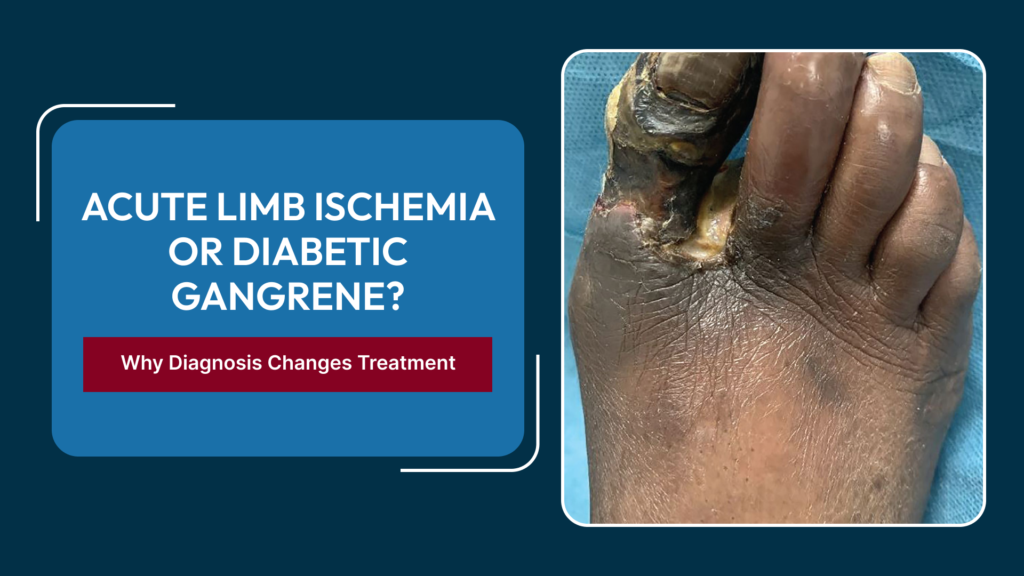
A cold, painful, discolored foot can point to two very different conditions: acute limb ischemia, a sudden arterial blockage that threatens the leg within hours, or diabetic foot gangrene, a slower process rooted in long-standing arterial disease, nerve damage, and infection. Both are limb-threatening and both need a vascular evaluation without delay, but the treatment clock runs very differently for each. A gangrene specialist doctor in Delhi starts every assessment by working out which of the two — or which combination — is driving the presentation, because that distinction decides whether the next step is an emergency procedure within hours or a staged, multidisciplinary plan over several days.
What Acute Limb Ischemia Looks Like
Acute limb ischemia (ALI) occurs when a limb artery is suddenly blocked, usually by an embolus that has traveled from the heart or a large vessel, or by thrombosis forming on top of an existing narrowed artery. The classic presentation is remembered as the ‘6 Ps’ — pain, pallor, pulselessness, paresthesia, paralysis, and poikilothermia (a cold limb) — appearing over minutes to hours. Because the tissue downstream has had no time to develop alternate blood supply, muscle and nerve damage can become irreversible within four to six hours of complete blockage, making ALI a true vascular emergency.
What Diabetic Foot Gangrene Looks Like
Diabetic foot gangrene develops over a longer timeline through a combination of peripheral arterial disease narrowing the blood vessels, peripheral neuropathy blunting pain and injury awareness, and infection taking hold in a wound the patient may not have felt forming. Tissue death typically follows an ulcer or minor injury that failed to heal because blood flow could not support it, and it often coexists with cellulitis, deep infection, or osteomyelitis (bone infection). The process unfolds over days to weeks rather than hours, but delay still allows infection and tissue loss to spread.
How the Two Are Told Apart
- Onset: ALI develops suddenly over minutes to hours; diabetic gangrene evolves over days to weeks.
- Pulses: ALI typically shows a sudden loss of a previously present pulse; diabetic patients often already have diminished pulses from chronic disease.
- Pain: ALI causes severe, sudden pain; diabetic patients with neuropathy may feel little or no pain despite significant tissue damage.
- Wound presence: gangrene is usually preceded by an ulcer, blister, or injury; ALI can occur in a limb with no prior wound at all.
- Trigger: ALI is often linked to an arrhythmia such as atrial fibrillation, or a hypercoagulable state; diabetic gangrene is linked to years of uncontrolled blood sugar and vascular disease.
Why the Distinction Changes the Treatment Plan
Acute Limb Ischemia: A Race Against Time
Confirmed ALI is managed as an emergency. Depending on severity and cause, treatment may involve immediate anticoagulation to prevent clot extension, surgical embolectomy to physically remove the clot, catheter-directed thrombolysis, or bypass surgery if the artery is chronically diseased underneath the acute clot. The priority is restoring blood flow before muscle and nerve tissue die, so imaging and intervention are compressed into hours, not days.
Diabetic Foot Gangrene: A Staged, Multidisciplinary Plan
Diabetic foot gangrene is managed differently — infection is controlled first with antibiotics and surgical debridement of dead tissue, blood sugar is brought under control, and blood flow is restored through angioplasty or bypass once the patient is stable enough for the procedure. Wound care, offloading pressure from the affected area, and close follow-up continue for weeks after the acute infection is treated, since healing in a diabetic foot is slower even after blood flow is restored.
The Diagnostic Work-Up
In both situations, a vascular assessment typically includes pulse examination, an ankle-brachial index or toe pressure measurement, Doppler ultrasound of the arteries, and CT angiography to map the exact site and extent of blockage. In suspected diabetic foot gangrene, imaging is paired with wound cultures and, where bone infection is suspected, an X-ray or MRI. This work-up is what separates a limb that needs an emergency thrombectomy from one that needs staged debridement and revascularization, and getting the sequence right is central to saving the limb.
Why Some Patients Have Elements of Both
In practice, the two conditions are not always cleanly separate. A diabetic patient with chronic peripheral arterial disease and an existing foot wound can develop a superimposed acute thrombosis or embolus on top of their chronic disease, producing a sudden worsening that looks like classic ALI layered on top of an already-compromised foot. Recognizing this overlap matters because it changes urgency — a chronically diminished pulse that suddenly disappears altogether, even in a diabetic foot with existing wounds, should prompt the same emergency work-up as ALI in a patient without diabetes, rather than being assumed to be part of the slower gangrene process already underway.
The Role of a Multidisciplinary Team
Because diabetic foot disease sits at the intersection of vascular surgery, endocrinology, infectious disease, podiatry, and wound care, outcomes tend to be best when these specialties coordinate rather than treat the foot in isolation. A vascular surgeon restores blood flow, an endocrinologist optimizes glucose control that affects healing, and wound care teams manage dressings and offloading over the following weeks — all working from the same diagnosis and timeline rather than in sequence with delays between each step.
Frequently Asked Questions
How quickly should a sudden cold, painful leg be evaluated?
Immediately. Suspected acute limb ischemia is a medical emergency where a few hours’ delay can mean the difference between saving and losing the limb, so a vascular evaluation should never be postponed.
Can diabetic patients develop acute limb ischemia too?
Yes. Diabetic patients can experience a sudden arterial blockage on top of their chronic arterial disease, and because neuropathy can mask the usual pain, the presentation may be subtler and easy to mistake for a slower gangrene process — which is why clinical assessment matters more than symptoms alone.
Does every case of diabetic foot gangrene need amputation?
No. Many cases are managed with debridement, infection control, and revascularization that saves the limb, with amputation reserved for tissue that is beyond salvage or when infection threatens the patient’s life.
What is the single biggest risk factor for both conditions?
Peripheral arterial disease underlies both — it sets the stage for sudden thrombosis in acute limb ischemia and for the slow tissue starvation that leads to diabetic foot gangrene.
Can these conditions be prevented?
Controlling blood sugar, blood pressure, and cholesterol, stopping smoking, regular foot checks for diabetic patients, and prompt treatment of any arrhythmia or clotting risk all reduce the chance of either condition developing.
A foot that is suddenly painful and cold, or a wound that is not healing, both need an urgent vascular opinion. Read more about limb-saving evaluation and treatment at Best Diabetic Foot Surgeon in Delhi

