India has the second-largest diabetic population in the world — over 100 million people — and for millions of them, the feet are silently at risk. Diabetic foot disease and gangrene remain the leading non-traumatic causes of lower limb amputation in this country. Yet in the majority of cases, amputation is not inevitable. With the right specialist intervention at the right time, most limbs can be saved. The challenge is that many patients — and even some non-specialist doctors — do not recognise the urgency of vascular evaluation when a diabetic develops a foot wound, discolouration, or persistent infection. By the time the correct specialist is consulted, the disease may have progressed significantly. This blog is written for diabetic patients, their families, and their primary care doctors in Delhi — to explain what diabetic foot disease really involves at the vascular level, what gangrene means for treatment decisions, and why Dr. Nikhil Chaudhari, the best diabetic foot surgeon in Delhi, should be among the first specialists consulted when foot complications arise.
The Vascular Root of Diabetic Foot Disease
Diabetic foot disease is not one condition but a combination of several problems that occur simultaneously and reinforce each other. Peripheral arterial disease (PAD) — the narrowing and hardening of the arteries supplying the legs and feet — develops earlier and more severely in diabetic patients than in the general population. High blood sugar damages the arterial wall, promotes the formation of atherosclerotic plaques, and reduces the elasticity of vessel walls. The result is impaired blood supply to the foot. A foot that receives inadequate blood cannot fight infection effectively, cannot heal wounds efficiently, and cannot maintain the normal tissue health that prevents breakdown. In parallel, diabetes causes peripheral neuropathy — loss of sensation in the feet — which means patients often do not feel when a wound, blister, or pressure sore is forming. By the time a diabetic patient notices a foot problem, it may already have been developing silently for days or weeks. The third component — a heightened susceptibility to infection — means that small wounds rapidly become infected with bacteria, and infections spread along tendons and fascial planes to involve deeper tissues quickly. Understanding that diabetic foot disease is fundamentally a vascular problem — one of inadequate blood supply — is the first step toward appropriate management. For a comprehensive evaluation of foot blood supply, the expertise of a vascular surgeon in New Delhi with specific training in peripheral arterial intervention is essential.
What Is Gangrene and What Does It Mean for Your Treatment Options?
Gangrene refers to the death of body tissue, almost always caused by inadequate blood supply (dry gangrene), bacterial infection superimposed on ischaemia (wet gangrene), or a combination of both. In the context of diabetic foot disease, wet gangrene is particularly dangerous because the combination of tissue death and active bacterial infection creates a life-threatening systemic illness. Dry gangrene — where the affected area desiccates and mummifies without active infection — is relatively stable and allows time for planning treatment. Wet gangrene is a surgical emergency requiring urgent debridement, infection control, and, critically, revascularisation — restoration of blood flow to the foot — if limb salvage is to be achievable. Many patients and families arrive at a gangrene specialist doctor in Delhi expecting to be told that amputation is the only option. In many of these cases, vascular assessment reveals that the underlying blood supply problem is treatable — that arteries which appear blocked on clinical examination can be opened using endovascular techniques, restoring the blood flow that allows wounds to heal and infection to clear. This is the central message of modern limb salvage: revascularisation first, debridement with the benefit of restored blood supply, and amputation only when no other option exists or when the extent of tissue destruction makes functional limb salvage impossible.
Peripheral Arterial Disease Assessment: What Happens During a Vascular Evaluation
When a diabetic patient presents with a foot wound, ulcer, discolouration, or signs of infection, a complete vascular assessment is the most important diagnostic step. This begins with a clinical history — duration of diabetes, current medications, smoking history, history of heart disease or kidney disease, and previous vascular procedures. Physical examination includes assessment of foot pulses (dorsalis pedis and posterior tibial arteries), skin temperature, capillary refill, and wound characteristics. Non-invasive vascular studies — ankle-brachial index (ABI), toe pressures, and transcutaneous oxygen measurement (TcPO2) — provide objective quantification of blood supply to the foot. If blood supply is found to be critically impaired, imaging is arranged to map the arterial anatomy. Duplex ultrasound, CT angiography, or conventional diagnostic angiography may be used depending on the clinical situation. The imaging findings determine whether endovascular revascularisation, open bypass surgery, or a combination approach is most appropriate. Dr. Nikhil Chaudhari, as a dual-trained vascular and endovascular surgeon in Delhi, can evaluate each patient’s anatomy and condition and choose the most appropriate revascularisation strategy — a capability that not every vascular specialist in the city possesses.
Endovascular Revascularisation: Opening Blocked Arteries Without Surgery
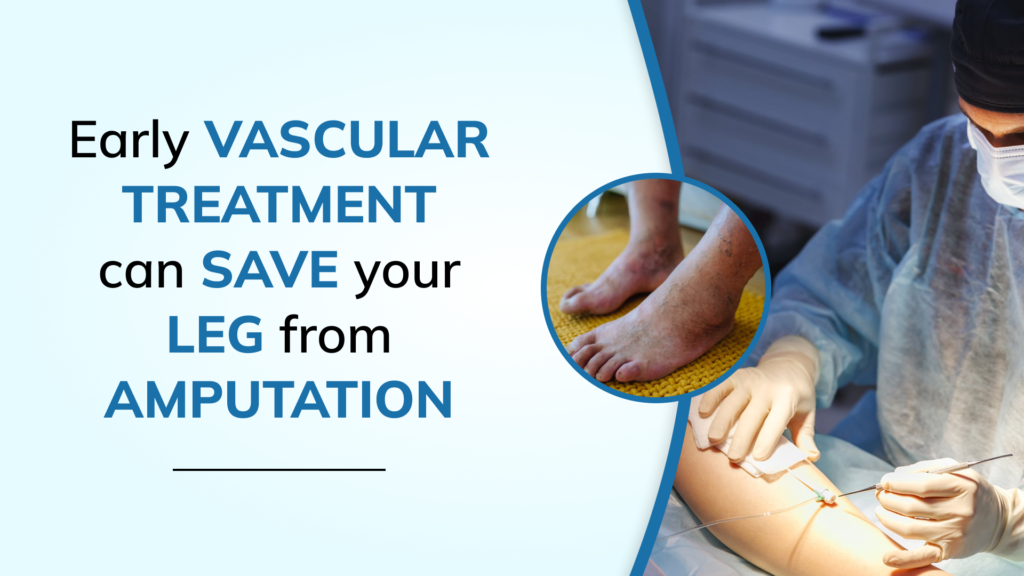
For most diabetic foot patients with peripheral arterial disease, the preferred first approach to revascularisation is endovascular — using catheters, balloons, and stents introduced through a small puncture to open blocked or narrowed arteries from within. This approach is particularly well-suited to the pattern of arterial disease seen in diabetics, which tends to affect the tibial and peroneal arteries in the lower leg — vessels that supply the foot directly. Using specialised low-profile balloons and drug-coated devices, these vessels can often be opened with excellent technical success even in complex, heavily calcified disease. The procedure is performed under local anaesthesia and mild sedation, without general anaesthesia or surgical incisions. Most patients can mobilise the same evening and are discharged within one to two days. When successful, revascularisation transforms the wound environment — a foot that previously had insufficient blood to mount an immune response or initiate healing suddenly has the resources to do both. Wound care and infection management become dramatically more effective in a revascularised foot. For patients across Delhi, Gurgaon, Noida, Faridabad, and Ghaziabad seeking a best endovascular surgeon in New Delhi for peripheral arterial disease, Dr. Nikhil Chaudhari’s clinic offers this complete spectrum of endovascular capability. To arrange an urgent vascular assessment, contact the clinic without delay.
The Role of DVT in Post-Surgical Vascular Patients
Patients undergoing vascular procedures — whether for diabetic foot disease, varicose veins, or other conditions — are at elevated risk of developing deep vein thrombosis in the post-operative period. DVT awareness and prevention is therefore an integral part of comprehensive vascular care. Patients and families should know the warning signs of DVT: unilateral leg swelling, warmth, redness, and a deep aching pain — particularly in the calf or thigh — that is often worse on standing or walking. If any of these symptoms develop, prompt evaluation by a DVT specialist in Delhi is essential. Duplex ultrasound of the veins can confirm or exclude the diagnosis within minutes, and anticoagulation therapy can be started immediately to prevent clot extension or pulmonary embolism. Dr. Nikhil Chaudhari’s practice includes comprehensive DVT treatment in Delhi for both surgical and non-surgical patients, including advanced options such as catheter-directed thrombolysis and mechanical thrombectomy for high clot burden cases.
Varicose Veins and the Diabetic Patient: An Underappreciated Interaction
Many diabetic patients also suffer from varicose veins — a condition that is often dismissed as cosmetic but that has important clinical implications. Varicose veins cause venous hypertension in the leg, which impairs tissue oxygenation at the skin level and predisposes to venous ulceration. In a diabetic patient who already has compromised arterial supply and impaired healing, the addition of venous hypertension from varicose veins significantly increases the risk of chronic, non-healing leg wounds. Treating varicose veins in diabetic patients using modern minimally invasive techniques — endovenous laser ablation or radiofrequency ablation — can remove one significant contributor to chronic wound formation. Patients in Delhi seeking the best varicose veins doctor in Delhi who also has expertise in managing the complex interactions between venous and arterial disease in diabetic patients will find that Dr. Nikhil Chaudhari’s dual expertise in both arterial and venous conditions makes him uniquely suited to manage these cases comprehensively.
When to Seek Help: A Message to Diabetic Patients and Their Families
The most important message in this blog is simple: do not wait. A diabetic foot wound that has not healed in two weeks, any new discolouration or darkening of the toes or foot, a wound that has become infected, increasing pain in the foot or leg at rest — these are all urgent indications for vascular specialist evaluation. The difference between a patient who undergoes timely revascularisation and walks out of the hospital with a healing foot and a patient who requires amputation is often nothing more than the speed at which they received the correct specialist care. Primary care doctors, diabetologists, and orthopaedic surgeons managing diabetic foot complications should have a clear and rapid referral pathway to a skilled vascular surgeon in Delhi who can assess and, where appropriate, restore blood supply before irreversible tissue loss occurs. To reach Dr. Nikhil Chaudhari’s team for an urgent evaluation or to discuss a complex case, please use the contact page. The right intervention at the right time does not just save limbs — it saves lives.