Introduction
Arteriovenous (AV) conditions — including AV fistulas and AV malformations — are among the more complex vascular disorders that require highly specialised knowledge and technical skill to diagnose and treat effectively. While these conditions are not as commonly discussed as varicose veins or DVT, they can have serious consequences for blood circulation, organ function, and quality of life if left unmanaged. Whether you have been newly diagnosed with an AV fistula or an AV malformation, or have been experiencing unexplained symptoms, consulting the best endovascular surgeon in Delhi is the critical first step towards effective care.
Understanding Arteriovenous Connections: The Basics
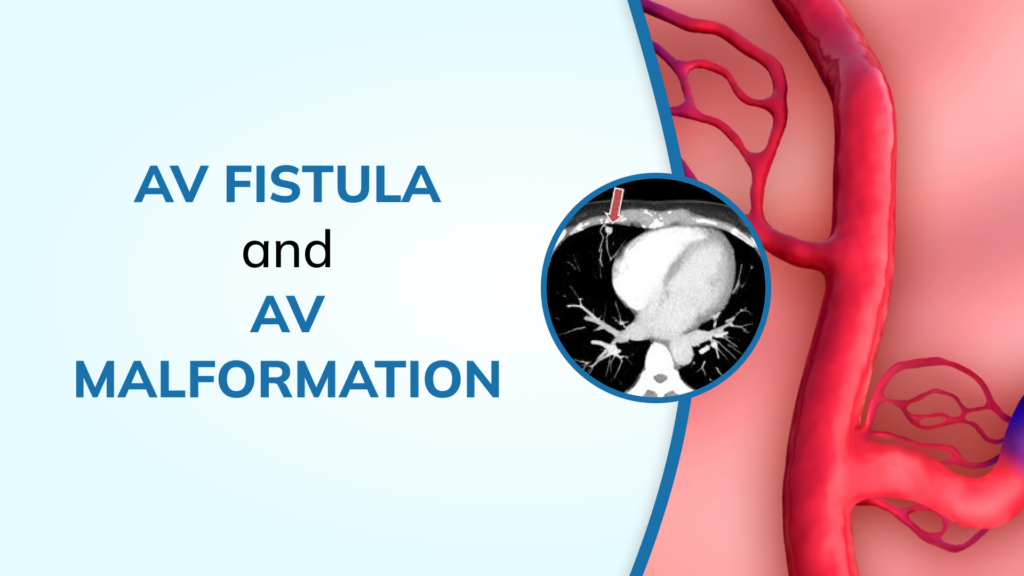
Under normal conditions, blood travels from the heart through arteries to the capillary network where oxygen is delivered to tissues, and then returns via the veins. In arteriovenous conditions, there is an abnormal connection between an artery and a vein that bypasses this capillary network. This short-circuit disrupts normal blood flow and can have a range of effects depending on the location, size, and type of connection.
What Is an AV Fistula?
An AV fistula is an abnormal connection between an artery and a vein. It may be:
Congenital AV Fistula
Present from birth, usually part of a broader vascular anomaly such as an AV malformation.
Acquired AV Fistula
Develops after trauma, surgery, or catheterisation — for example, after a stabbing injury, fracture, or iatrogenic injury during a medical procedure. A common example is the dialysis AV fistula surgically created in the forearm for haemodialysis patients — this is a deliberate, therapeutically constructed fistula.
Acquired peripheral AV fistulas can cause a range of problems including local swelling, venous hypertension, high-output cardiac failure (if large), and limb ischaemia. The best vascular surgeon in New Delhi will evaluate each case comprehensively to determine the most appropriate intervention.
What Is an AV Malformation?
An AV malformation (AVM) is a complex tangle of abnormal blood vessels directly connecting arteries and veins — forming a ‘nidus’ (a core cluster of vessels) that lacks the normal intervening capillary bed. AVMs are generally congenital (present from birth) though they may not become symptomatic until later in life.
AV malformation treatment is highly complex and typically requires a multidisciplinary team that may include vascular surgeons in New Delhi, interventional radiologists, and neurologists, depending on the location.
Common Locations of AV Malformations
- Brain and spinal cord (neurological AVMs) — carry risk of intracranial haemorrhage
- Peripheral limbs — can cause pain, swelling, discolouration, and skin changes
- Lung (pulmonary AVMs) — may cause low blood oxygen and risk of stroke
- Liver and GI tract — can lead to high-output cardiac failure
Symptoms of AV Fistula and AV Malformation
Symptoms vary widely based on location and size. Common presentations include:
- Pulsatile swelling or mass in the limb
- A bruit (audible whooshing sound) heard over the lesion with a stethoscope
- Warmth and discolouration of overlying skin
- Progressive limb enlargement
- Non-healing wounds or ulcers near the lesion
- Heart palpitations or signs of high-output cardiac failure in large lesions
- Neurological symptoms for intracranial AVMs — headaches, seizures, or weakness
Diagnosis: How AV Conditions Are Evaluated
The endovascular surgeon in New Delhi uses a combination of diagnostic tools to evaluate AV fistulas and malformations:
- Duplex Ultrasound — identifies abnormal arteriovenous flow patterns
- CT Angiography (CTA) or MR Angiography (MRA) — provides detailed 3D mapping of vascular anatomy
- Digital Subtraction Angiography (DSA) — the gold standard for AV malformation evaluation, performed in a catheterisation suite
Treatment Options for AV Fistula and AV Malformation
1. Embolisation
Embolisation is a minimally invasive endovascular technique in which the abnormal vessels are blocked using embolic agents (glue, coils, particles, or foam) delivered through a catheter. This is often the first-line treatment for AV malformations and acquired fistulas. The best endovascular surgeon in Delhi performs embolisation under fluoroscopic guidance with precision targeting of the nidus or fistula tract.
2. AV Fistula Angioplasty
For dialysis AV fistulas that have developed stenosis (narrowing) — a common problem in long-term haemodialysis patients — AV fistula angioplasty is the preferred treatment. Using a balloon catheter delivered through a small puncture, the stenotic segment is dilated to restore adequate blood flow through the fistula and maintain dialysis access. In some cases, a stent may be placed if the stenosis recurs. AV fistula angioplasty is a short, minimally invasive procedure with rapid recovery, avoiding the need for surgical revision.
3. Surgical Resection
In cases where embolisation alone is not sufficient or where the AVM is confined to a resectable area, surgical excision may be recommended. Surgery is often combined with pre-operative embolisation to reduce blood loss during resection. The vascular surgeon in New Delhi will plan this approach meticulously in conjunction with the interventional team.
4. Stereotactic Radiosurgery
For brain AVMs that are small and surgically inaccessible, stereotactic radiosurgery (e.g., Gamma Knife) uses focused radiation beams to obliterate the AVM nidus over 1 to 3 years. This approach is particularly useful for AVMs in eloquent brain regions where surgical access carries high neurological risk.
5. Observation and Medical Management
Not all AVMs require immediate intervention. For asymptomatic, small, and low-risk lesions, a watch-and-wait strategy with regular imaging follow-up may be appropriate. This decision is made collaboratively between the patient and the best vascular surgeon in New Delhi based on lesion characteristics, patient age, and comorbidities.
Dialysis AV Fistula: A Special Context
The surgically created AV fistula is the preferred vascular access for patients undergoing long-term haemodialysis for kidney failure. While it is a deliberately created connection, it can develop complications over time including stenosis, thrombosis, aneurysmal dilation, and infection. AV fistula angioplasty performed by the best endovascular surgeon in Delhi is the first-line treatment for fistula stenosis, offering a minimally invasive solution that prolongs the life of the access without surgery.
Why Expertise Matters in AV Conditions
AV fistulas and malformations require a rare combination of technical skill, deep anatomical knowledge, and experience in advanced endovascular techniques. The best vascular surgeon in Delhi brings all of these together — offering patients in Delhi access to world-class vascular care without the need to travel abroad.
Conclusion
AV fistulas and AV malformations are complex vascular conditions that require accurate diagnosis and carefully planned treatment. From AV fistula angioplasty for dialysis patients to endovascular embolisation for congenital malformations, the range of treatment options available through the best endovascular surgeon in Delhi has never been more advanced. If you suspect you have an AV fistula or malformation, or if you have been recently diagnosed, do not delay seeking a specialist opinion.
Frequently Asked Questions (FAQs)
Q1: Is AV malformation the same as a haemangioma?
No. A haemangioma is a benign tumour made of extra blood vessels and typically appears in infancy and regresses. An AV malformation is a structural vascular anomaly that does not regress and usually requires active AV malformation treatment.
Q2: Can AV fistulas be dangerous?
Large acquired AV fistulas can cause high-output cardiac failure, limb ischaemia, and venous hypertension — all of which are serious. Early intervention by a vascular surgeon in Delhi is recommended.
Q3: How long does AV fistula angioplasty take?
AV fistula angioplasty is typically completed within 30 to 60 minutes under local anaesthesia as an outpatient procedure.
Q4: Can AV malformations come back after treatment?
Recurrence is possible, particularly for complex high-flow AVMs. Lifelong surveillance imaging is recommended for most patients following AV malformation treatment.
Q5: Where can I find the best vascular surgeon in New Delhi?
You can find the best vascular surgeon in New Delhi at bestvascularsurgeondelhi.com — offering comprehensive care for all vascular conditions including AV fistulas, AV malformations, DVT, varicose veins, aortic aneurysm, and more.
Concerned about an AV fistula or AV malformation? Consult the best endovascular surgeon in Delhi for a complete vascular evaluation. Visit bestvascularsurgeondelhi.com to schedule your consultation today.